
Agentic Commerce
Exploring the foundations shaping the new payments landscape.

This week, Google announced its Agent Payments Protocol (AP2), a technical framework endorsed by over 60 payments companies, including Mastercard, American Express, PayPal, Coinbase, Adyen, and Worldpay.
The announcement marks a significant milestone in the development of agentic commerce, a shift toward AI agents autonomously executing purchases on behalf of users.
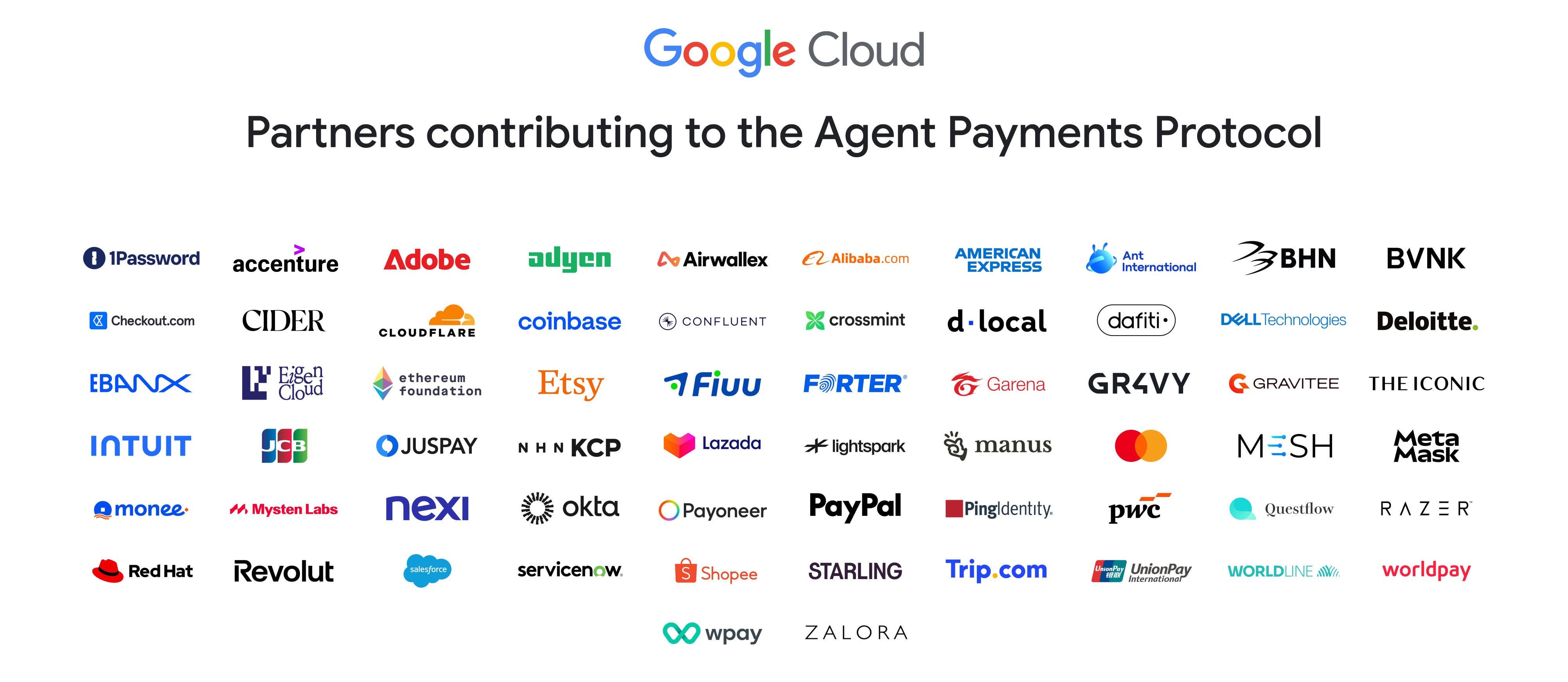
But Google's protocol is just the latest development in a rapidly evolving landscape. Over the past six months, major payment networks and platforms have been positioning themselves for a fundamental change in how transactions occur. Instead of humans navigating websites and filling out checkout forms, AI agents will discover products, negotiate prices, and complete purchases entirely autonomously.
For payments companies, this represents more than a new channel; it's a complete reimagining of how value flows through the payments ecosystem.
Understanding these developments isn't just about keeping up with innovation; it's about positioning your organization for relevance in a world where the customer interface increasingly disappears.
So let me explain what this means…
What Is Agentic Commerce?
Agentic commerce describes transactions initiated and completed by AI agents rather than direct human interaction. These agents operate under pre-approved mandates from users, allowing them to make purchasing decisions within defined parameters.
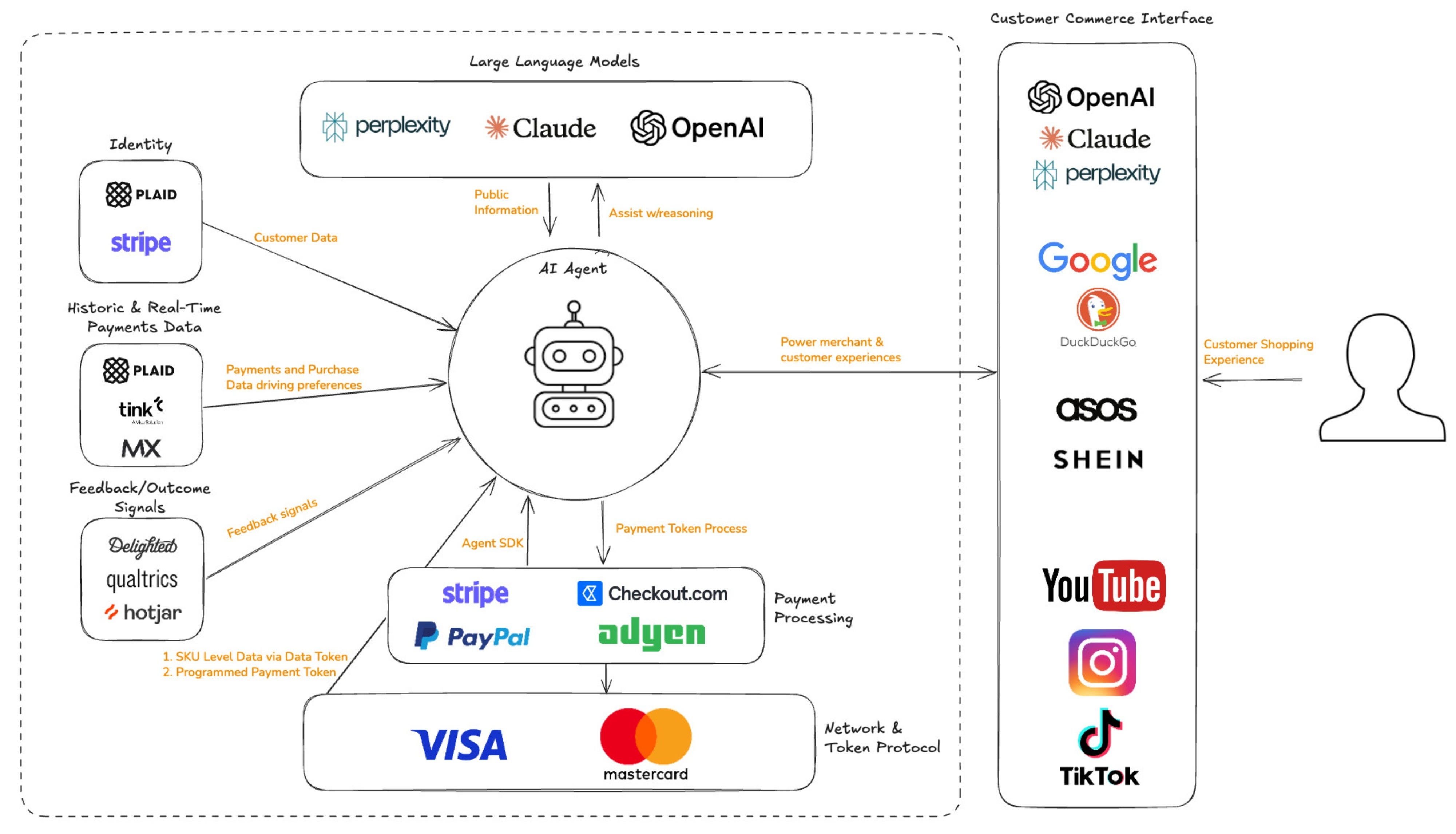
Source Image: Fintech Under the Hood
The concept extends far beyond simple automation. While traditional payment automation follows rigid rules, like recurring subscriptions or scheduled transfers, agentic systems can interpret intent, compare options, and make contextual decisions. An agent might book flights by comparing prices across airlines, adjusting travel dates based on cost savings, and selecting seats according to user preferences, all without human intervention.
The technical requirements for agentic commerce differ significantly from human-driven transactions. Agents need machine-readable product catalogs, real-time pricing APIs, and standardized interfaces for order creation. They require structured data that can be parsed and compared programmatically, not marketing content designed for human consumption.
From a payments perspective, agentic commerce introduces new authentication models, risk assessment frameworks, and settlement patterns. Traditional fraud detection systems, built to identify human behavioral patterns, must evolve to distinguish between legitimate agent activity and potential abuse.
The Six-Month Infrastructure Race
The foundation for agentic commerce has been laid through a series of strategic moves by major payments players throughout 2025.
Visa's IntelligentCommerce Approach
Visa launched IntelligentCommerce in May, focusing on credential management for autonomous transactions. Their system provides AI agents with network tokens and spending limits, allowing execution on VisaNet without exposing raw card data. The approach extends Visa's existing tokenization infrastructure to handle agent-initiated transactions.

Key partnerships with OpenAI, Microsoft, and Nvidia demonstrate Visa's strategy: if they control the credential vault that agents access, they maintain relevance regardless of how the user interface evolves. IntelligentCommerce essentially treats agents as another form factor for accessing existing Visa rails.
Mastercard's Rail-Agnostic Strategy
Mastercard's AgentPay, launched alongside their broader Agent initiatives, takes a different approach through their Multi-Token Network. Rather than focusing solely on card credentials, the system enables agents to settle through cards, bank-linked tokens, or regulated stablecoins.
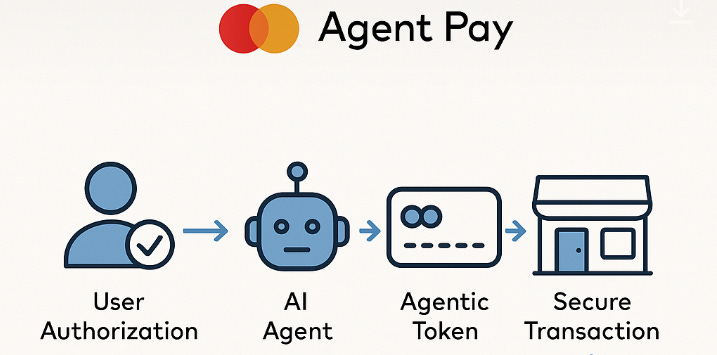
This rail-agnostic positioning reflects Mastercard's view that agentic commerce will fragment across multiple settlement methods. Their partnerships with enterprise platforms like Salesforce, Shopify, and Adobe Commerce indicate a focus on enabling existing merchant infrastructure rather than creating new rails.
PayPal's Developer-First Strategy
PayPal released its Agent Toolkit in April, which provides comprehensive API coverage for orders, invoices, subscriptions, and dispute management. The toolkit provides Python and TypeScript libraries that integrate directly with popular AI frameworks, including LangChain, OpenAI's SDK, and Amazon Bedrock.
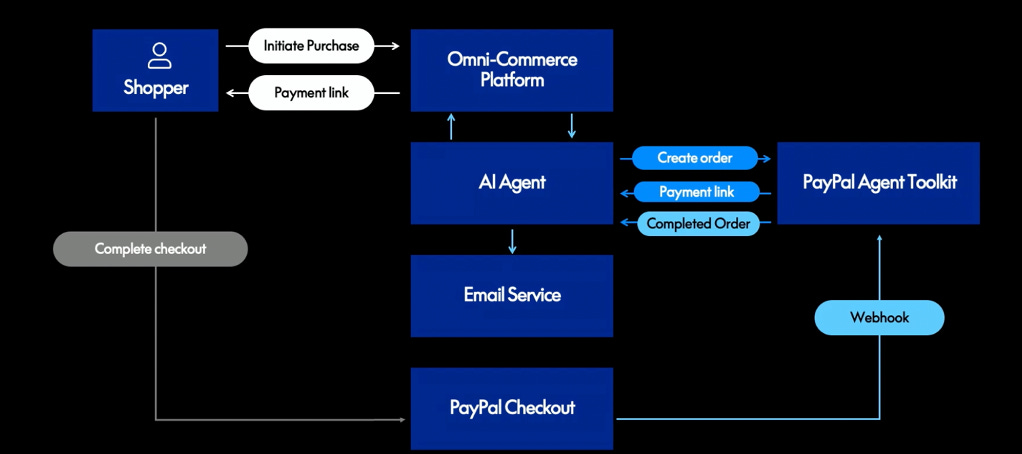
PayPal's approach prioritizes speed of implementation over protocol control. By making it easy for developers to add payments to agent workflows, they aim to capture volume through developer adoption rather than infrastructure control.
Google's Technical Foundation
Google's AP2 represents the most comprehensive technical framework for agentic commerce released to date. The protocol establishes standardized methods for agent discovery, transaction authorization, and settlement across multiple payment methods.
AP2's mandate system creates cryptographically signed contracts between users, agents, and merchants. Intent Mandates capture pre-approved spending conditions, while Cart Mandates provide explicit authorization for specific purchases. These mandates serve as tamper-proof audit trails using W3C Verifiable Credentials standards.
The protocol's architecture separates distinct roles: users originate intent, agents execute tasks, credential providers handle payment security, and merchants process mandates. This separation enables PCI compliance through architectural design while keeping sensitive payment data isolated from AI systems.
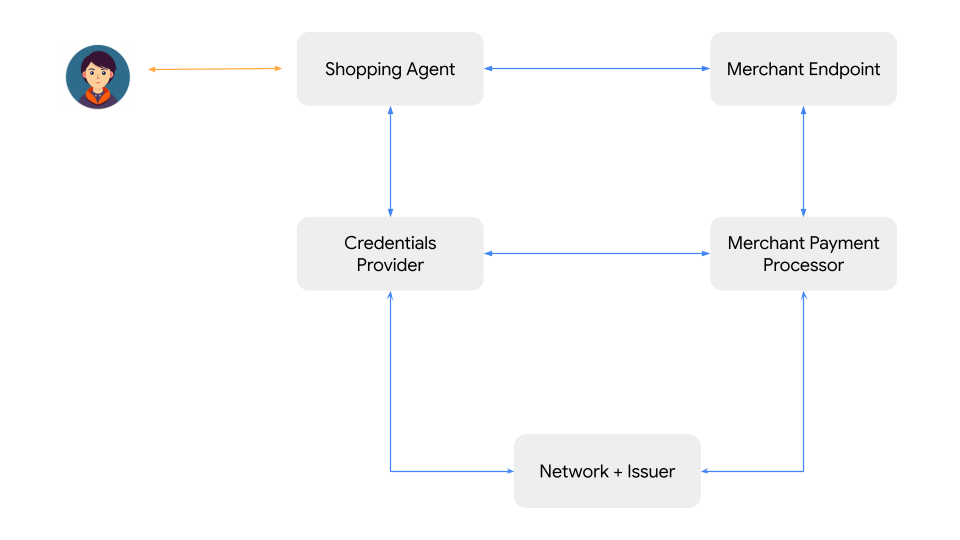
Perhaps most significantly, AP2 includes the x402 extension for cryptocurrency payments, developed with Coinbase and the Ethereum Foundation. This positions the protocol at the intersection of traditional and digital payments, potentially providing a unified framework as payment methods continue to diversify.
The Open Alternative: Basis Theory's Consortium
While major networks have focused on extending their existing infrastructure, Basis Theory has pursued a different path with its Open Agentic Commerce specification. Their approach emphasizes merchant control rather than platform dependency.
The Basis Theory consortium has published a complete technical specification defining how merchants can expose agentic commerce capabilities regardless of their existing payment infrastructure. The specification centers on standardized manifests, discoverable files that tell agents what capabilities a merchant offers.
Key components include:
Product discovery through Schema.org aligned catalogs
Deterministic order creation with complete pricing breakdown
Modular authentication supporting multiple methods
Unified payment endpoints compatible with existing processors
What distinguishes this approach is its focus on merchant independence. Rather than requiring integration with specific network protocols, merchants can implement the specification using their existing payment stack. The result is agentic commerce capabilities without platform lock-in.
The consortium includes companies across the payments ecosystem, processors, gateways, platforms, and infrastructure providers, united around open standards rather than proprietary control.
Understanding the Strategic Positions
Each approach reflects different assumptions about where value will concentrate in agentic commerce:
Network Extension Strategies (Visa, Mastercard) assume that existing payment rails remain central, with agents simply providing new access methods. Success depends on maintaining control over transaction routing and settlement.
Platform Integration Strategies (PayPal, Google) focus on capturing agent ecosystem integration. Value comes from being the preferred payment method for AI frameworks and agent developers.
Open Standard Strategies (Basis Theory, others) bet that merchant control and interoperability prevent any single platform from dominating. Success requires widespread adoption of open specifications.
These aren't mutually exclusive approaches.
Many merchants will need to support multiple protocols, and agents will need to work across different payment methods. The question is which approach becomes the default integration path for new agentic commerce implementations.
Practical Steps for Payments Companies
For most payment companies, the question isn't which protocol will dominate, but how to ensure their organization remains relevant as agentic commerce develops.
So how do you prepare for that?
Assess Your API Readiness
Agentic commerce requires machine-readable interfaces for all core functions: product catalogs, pricing, inventory, order creation, and payment processing. If your current systems primarily serve human interfaces, agent integration will require significant additional development.
Audit your existing APIs for agent compatibility:
Can agents discover your product catalog programmatically?
Do you provide real-time pricing and availability?
Can orders be created with deterministic totals before payment?
Are your payment methods accessible via standard protocols?
Understand Protocol Requirements
Different protocols have different integration requirements. AP2 requires mandate processing capabilities and W3C Verifiable Credentials support. MCP requires JSON-RPC 2.0 compatibility. Basis Theory's specification needs Schema.org aligned data structures.
Rather than choosing a single protocol, plan for multi-protocol support. The agents your customers use will determine which protocols you need to support, not your internal preferences.
Implement Agent-Friendly Fraud Detection
Traditional fraud detection systems flag unusual patterns, but agent behavior differs significantly from human behavior. Agents may place many small orders in sequence, purchase across multiple categories simultaneously, or exhibit other patterns that human-focused systems consider suspicious.
Develop agent-aware risk models that evaluate transactions against their originating mandates rather than historical human patterns. Ensure your systems can distinguish between legitimate agent activity and actual fraud.
Plan for Mandate Management
Agent transactions operate under pre-approved spending conditions. Your systems need capabilities to validate these mandates, enforce spending limits, and maintain audit trails for compliance purposes.
This includes technical infrastructure for processing cryptographically signed mandates and business processes for handling disputes, modifications, and revocations of agent spending authority.
Build Partnership Strategies
Unless you're building agent capabilities internally, success requires partnerships with AI platform providers, agent framework developers, or agentic commerce facilitators.
Identify the agent platforms most relevant to your customer base and establish integration roadmaps. This might mean becoming certified with major payment platforms, integrating with AI framework providers, or participating in industry standards development.
The Path Forward
Agentic commerce represents a fundamental shift in how transactions occur, moving from human-initiated to agent-executed payments. The infrastructure being built today will determine which organizations remain relevant as this transition accelerates.
The timeline for adoption is compressing rapidly.
Production implementations already exist across major platforms, and the technical frameworks are solidifying around established protocols. Companies that delay risk finding themselves excluded from agent-driven commerce channels.
Success requires understanding that agentic commerce isn't just about adding new APIs; it's about reimagining how your organization delivers value in a world where the customer interface increasingly disappears. The winners will be those who enable seamless agent interactions while maintaining the security, compliance, and control that payments require.
The foundations are being laid now. The question is whether your organization will help build them or simply adapt to what others construct.
Thank You for Reading. Please like, Comment, Share, or Post on Your Social media. I appreciate all the feedback I can get.
P.S. If you're interested in collaborating with me on a larger scale, whether through speaking, advisory services, or consulting, please don't hesitate to email or DM me.
Thanks for featuring my agentic deep dive Dwayne :-)
Thanks for explaining in detail